Barrier removal has become one of the most effective and rapidly growing nature-based solutions for restoring river connectivity and recovering freshwater ecosystems (Darre et al. ,2025). For centuries, European rivers have been modified by human-made structures such as dams, weirs, culverts, and other barriers built for different purposes. Today, many of these structures have lost their original function and are considered obsolete. It is estimated that there are around 156.000 obsolete barriers across Europe (Belleti et al., 2020). In recent years, barrier removal has gained strong momentum as a practical restoration measure, bringing a wide range of benefits. From ecological recovery to socio-economic improvements, removing obsolete barriers helps rivers regain their natural dynamics and supports both nature and people.
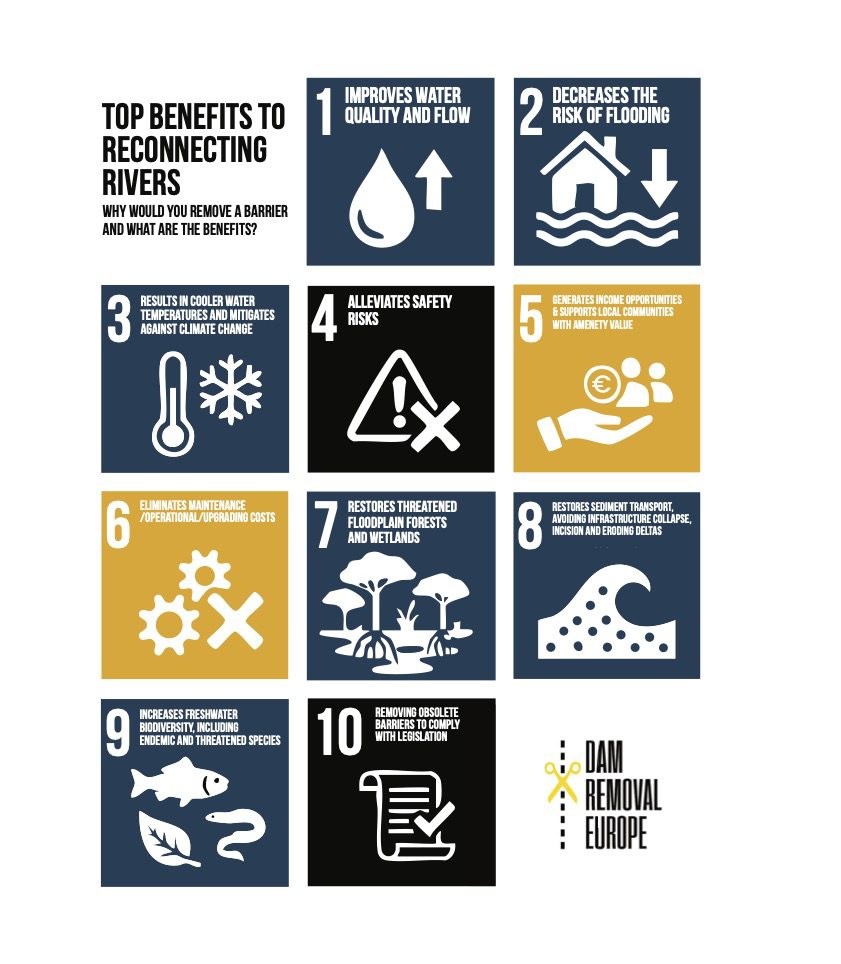
Why to remove a dam
Below, we explain why:
Removal of Ackers Weir in the United Kingdom
The removal of the Ackers Weir on the River Cole in the United Kingdom in 2022 contributed to improvements in water quality and flow. The weir resulted in the accumulation of contaminated sediments being trapped upstream. Contaminated sediments were treated simultaneously with the removal of the weir. As a result, contaminated sediments could not be washed downstream. Barrier removal also contributed to natural river flow and restoring downstream sediment movement (GOV UK Environment Agency, 2023; Sanctus, n.d.).
Improves water quality and natural flow
Image 1. Ackers Weir (GOV UK Environment Agency, 2023)

Decreases the risk of flooding
Removal of San Marcos Weir in Spain
The San Marcos weir on the Bernesga River in León, Spain, provided safety benefits in the area. The weir was partially demolished in 2013 to reduce flood risks. A year after the removal, a significant flood event occurred. This flood would have flooded part of the city of León if the weir had not been partially removed (Confederación Hidrográfica del Duero, 2013; Restoring Europe’s Rivers, 2019).
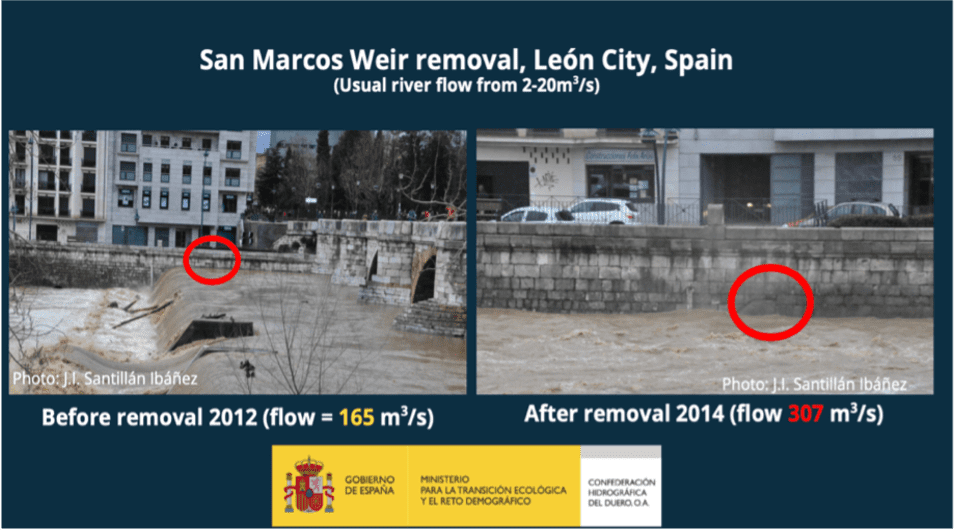
Image 2: Water levels before and after the San Marcos Weir removal taken by José Ignacio Santillán Ibañez (Duero River Basin Authority)

Results in cooler water temperatures and mitigates against climate change
The Removal of Dams in Sélune River in France
The removal of the dams on the Sélune River in France in 2022 had a positive effect on water temperature, among other benefits. Scientists found that, after dam removal, the river’s temperature downstream decreased by 2°C during the hottest period of summer, compared with previous years (Dam Removal Europe, 2019; MacErlean, 2025; Fovet et al., 2023).
Image 3: Vezins Dam taken by Iwan Hoving – WFMF (Dam Removal Europe, 2019)

Alleviates safety risks
Approximately 156,000 barriers in Europe are obsolete (Beletti et al., 2020). Some of them pose a breach risk that threatens human safety and property. Barrier removal can alleviate such incidents, save lives and prevent spending millions in repairing damages (Bellier, 1967, in Biscarini et al., 2016). In addition, low-head barriers (i.e., weirs), among other types of barriers, are dangerous due to the formation of an inescapably strong subsurface current (submerged hydraulic jump). These structures, usually called “drowning machines”, have caused hundreds of fatalities in Europe and the USA (Mouchlianitis, 2024; Clark and Wheeler, 2023). Removal of such barriers – especially if obsolete – can save human lives.
The Removal in Pčinja River basin in North Macedonia
North Macedonia’s first barrier removal in the Pčinja River basin in 2025 has helped alleviate safety risks. Eko-svest removed 2 barriers, restoring 72 km of river. As a result of the successful project, flood and safety risks for communities were reduced (Open Rivers Programme, n.d.-a).
Image 4. Removal on Pčinja River, North Macedonia – Eko-svest (Open Rivers Programme ,n.d. -a)

Generates income opportunities & supports local communities with amenity value
Nature restoration measures, like barrier removal, return the initial investment 8- to 38-fold through the gained ecosystem services (European Commission, 2022). In addition, barrier removal can be presented as a business model for construction companies (Macdonald, 2025). Finally, barrier removal supports recreational businesses or activities such as angling, canoeing, kayaking, swimming, wildlife viewing and hiking (Born et al., 1998; Leisher et al., 2021).
The Removal in Havørred Fyn project in Denmark
The removal of barriers began in the 1990s with the Havørred Fyn project in Denmark, which supported local communities through angling tourism. Barrier removal in Havørred Fyn generated an estimated 5.8 million euros per year in angling tourism, compared to a 0.5 million euro per year initial investment through dam removal (The Nature Conservancy, n.d.; Havørred Fyn, n.d.).
Image 5. Seatrout Fyn (Havørred Fyn, n.d.)

Eliminates maintenance/ operational/ upgrading costs
The Removal of hydropowers in River Hiitolanjoki in Finland
Image 6. Demolishing of a Dam in Hiitolanjoki River (taken by Mikko Nikkinen in Dam Removal Europe, n.d.-a)
Restores threatened floodplain forest and wetlands
Barriers impact the natural flooding regimes of floodplains (EEA, 2019). Sediment trapping by barriers results in downstream sediment shortages, which erode riverbeds and banks rather than depositing material. Over time, the deepening of the channels (incisions) lowers the river’s elevation relative to the floodplain. This confines water within the riverbanks and disconnects the river from the floodplain, adversely affecting biodiversity that depends on these floodplains, including aquatic vegetation, waterbirds, and invertebrate populations (Wenskus et. al, 2025; Fields et. al, 2025; Merlin, 2024).
The Removal in Foki sidearm in Slovakia
Image 7. Foki Arm after Barrier Removal (WWF-Slovakia, n.d.)
Restores sediment transport, avoiding infrastructure collapse, incision and eroding deltas
Many barriers trap sediment impeding its natural deposition around bridge piers and other instream infrastructure, as well as in estuaries and river deltas (Aoula et al., 2021; Pizarro et al. 2020). Removal of barriers restores local natural sediment flow and deposition, which takes a longer (multi-year) period and is driven by events like floods and high flows and thus prevent structural issues, and increase deltas and estuaries’ resilience against sea level rise, storm surges and salt water intrusion (Cheng & Granata, 2007; Fields et al., 2025; Dunn et al., 2009).
The Removal of Hornbachsperre in Austria
Image 8. Hornbachsperre (taken by Toni Vorauer in WWF, 2021)

Increases freshwater biodiversity, including endemic and threatened species
Barriers are a major pressure on freshwater biodiversity (Reid et al., 2018; Tickner et al. 2020). Freshwater migratory fish in particular have suffered a 93% decrease in their populations in Europe since 1970, mainly due to river fragmentation by manmade barriers (Deinet et al., 2024). Barrier removal restores fish passage and thus fish populations, but also favors macro-invertebrate biodiversity, boosts plant biodiversity, and restores connectivity, also benefiting other aquatic species, like otters (Zydlewski et al., 2023; Santucci et al., 2005; Maloney et al. 2008; Shafroth et al., 2002; Brown et al., 2022; Kloskowski et al. 2013).
The Removal of Culverts in Rulles Basin in Belgium
Image 9. Removal of Culverts in Rulles Basin (Dam Removal Europe, n.d.-b)

Removing obsolete barriers to comply with legislation
The Removal of Barriers in Vindel River in Sweden
The removal of 5 migration barriers in the Vindel River, Sweden, in 2025 opened up more than 100 km of river in the Nature2000 site and UNESCO biosphere reserve. Aside from the ecological benefits of the removal, the project supported the legally binding European Union (EU) target of restoring at least 25.000 km of rivers within the EU Nature Restoration Law (Open Rivers Programme, n.d.-b).
Image 10. the Vindel River in Sweden (Open Rivers Programme, n.d.-b)